Negotiating Volume Tiers for Arctic — Scaling Up
VapeWholesaleHub Arctic · Arctic cooling formulations
Most conversations about negotiating Volume Tiers for Arctic — Scaling Up start in the wrong place. Someone asks for a price per unit before anyone has agreed what the unit actually is. This page works through the subject the way a purchasing desk experiences it, from the first sample request to the container arriving at the dock.
What quality control looks like in practice
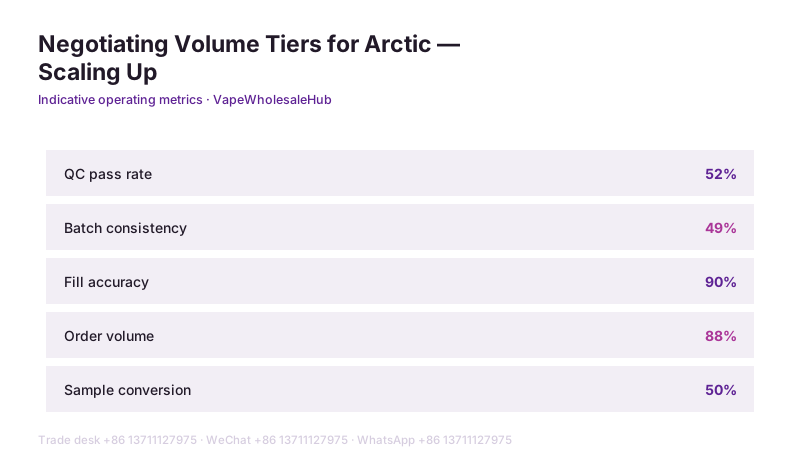
A quality system for negotiating Volume Tiers for Arctic — Scaling Up should produce a number someone is accountable for. Defect rate per batch, days to resolution, repeat complaint rate. Without a number, quality becomes an opinion, and opinions do not survive a busy quarter.
Quality control on negotiating Volume Tiers for Arctic — Scaling Up is unglamorous and repetitive, which is exactly why it works. Incoming inspection, fill weight checks, leak testing and a retained sample from every batch. None of this is clever; all of it is cheaper than a recall.
Documentation and regulatory reality
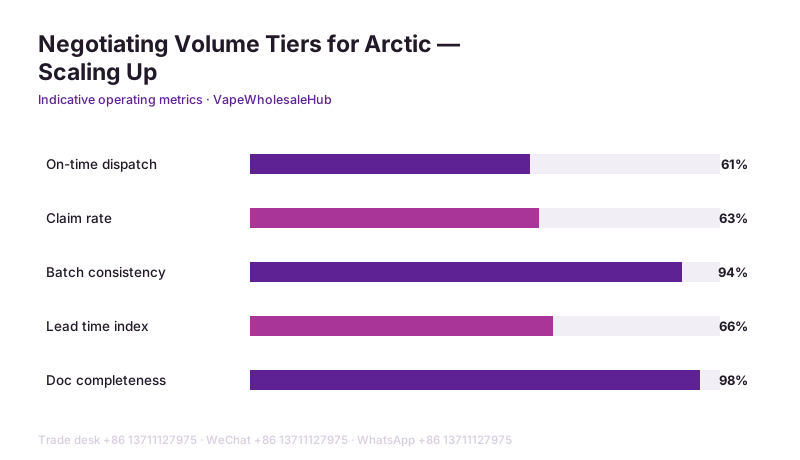
Compliance is where negotiating Volume Tiers for Arctic — Scaling Up either holds together or quietly falls apart. Regulators are not interested in intent; they want documents that match the physical goods. If the label says one thing and the test report says another, the shipment is the problem, not the paperwork.
Buyers sometimes treat compliance for negotiating Volume Tiers for Arctic — Scaling Up as a cost to be minimised. It reads better as a moat. When the market tightens, the accounts that already hold complete technical files keep trading while everyone else scrambles to produce paperwork that should have existed a year earlier.
Where the supply actually comes from
A useful test for negotiating Volume Tiers for Arctic — Scaling Up is to ask two suppliers the same uncomfortable question and compare how long the answer takes. Serious operations have the data ready. Everyone else needs to check with someone, and that delay tells you how the next twelve months will feel.
On the sourcing side, negotiating Volume Tiers for Arctic — Scaling Up comes down to how much of the chain you can see. A trading desk that only ever talks to a sales rep is buying on faith. We prefer accounts that ask for the factory audit, the mixing records and the batch numbers, because that paperwork is what protects everyone when a shipment is questioned later.
The commercial side of the decision
The accounts that grow steadily on negotiating Volume Tiers for Arctic — Scaling Up tend to do one boring thing well: they reorder before they run out. It sounds obvious. In practice, most wholesale buyers reorder late, pay for expedited freight, and then blame the supplier for the cost.
Margin on negotiating Volume Tiers for Arctic — Scaling Up is usually set by the structure of the deal, not the sticker. Payment terms, freight responsibility, breakage allowance and return rights all move the real number. We would rather agree a clean structure with a fair price than a low price with vague terms that get argued about later.
Order structure at a glance
| Item | Standard | Volume | Programme |
|---|---|---|---|
| Typical order unit | Master carton | Pallet | Full container |
| Documentation | COA + SDS | COA + SDS + batch record | Full technical file |
| Lead time | 2-4 working days | 5-10 working days | 15-25 working days |
| Customisation | Label only | Label + closure + bottle | Full OEM / ODM |
| Sampling | Charged, credited on order | Included in development | Multi-round approval |
| Indicative MOQ | 1200 units | 6,000 units | 24,000 units |
| Development window | n/a | 3-5 working days | 3-5 + approval |
Common questions
What is the usual minimum order quantity?
Minimum order quantity depends on the line. Standard stock items typically start at a single master carton, while custom work, private label artwork and bespoke tooling carry higher thresholds because the setup cost has to be recovered. We publish the figure for each line rather than quoting one blanket number.
What shelf life should we plan around?
Unopened e-liquid is typically stable for around two years when stored cool and away from direct light, and device batteries lose capacity on a similar curve. We print manufacture dates and batch codes on every unit so stock rotation is straightforward.
Can you supply documentation for our regulator?
Yes. Technical files, certificates of analysis, safety data sheets and batch records are provided with shipments on request. Tell us which national scheme you operate under at the enquiry stage and we will confirm exactly which documents come as standard.
Related reading
- Arctic and Warehouse Slotting Decisions — Contract Supply Guide
- Arctic Vape Orders: Customs and Clearance Notes — Distributor Focus
- Lead Times and perceived intensity for Arctic Orders — Regional Depot Guide
- Arctic Vape Supply Notes 912
- Arctic Vape Supply Notes 754
- Why Arctic Matters in stability over time — Contract Supply Guide
Talk to the wholesale desk. Specifications, MOQ, stock and freight options for negotiating Volume Tiers for Arctic — Scaling Up.
Phone +86 13711127975 · WeChat +86 13711127975 · WhatsApp +86 13711127975